
Walk into almost any dermatology clinic that treats hair loss, and you’ll hear the same three letters sooner or later: PRP.
It’s popular for a reason. PRP (platelet-rich plasma) is built on an elegant biological premise: platelets are not just “clot cells” — they are tiny packets of signaling molecules. When activated, they release growth factors and cytokines that can influence repair, inflammation balance, vascular support, and cellular behavior. For hair, that matters because the follicle is a living mini-organ that responds to signals from its neighborhood. And yet—if you speak to clinicians honestly, and if you listen to patients carefully, you’ll also hear another truth:
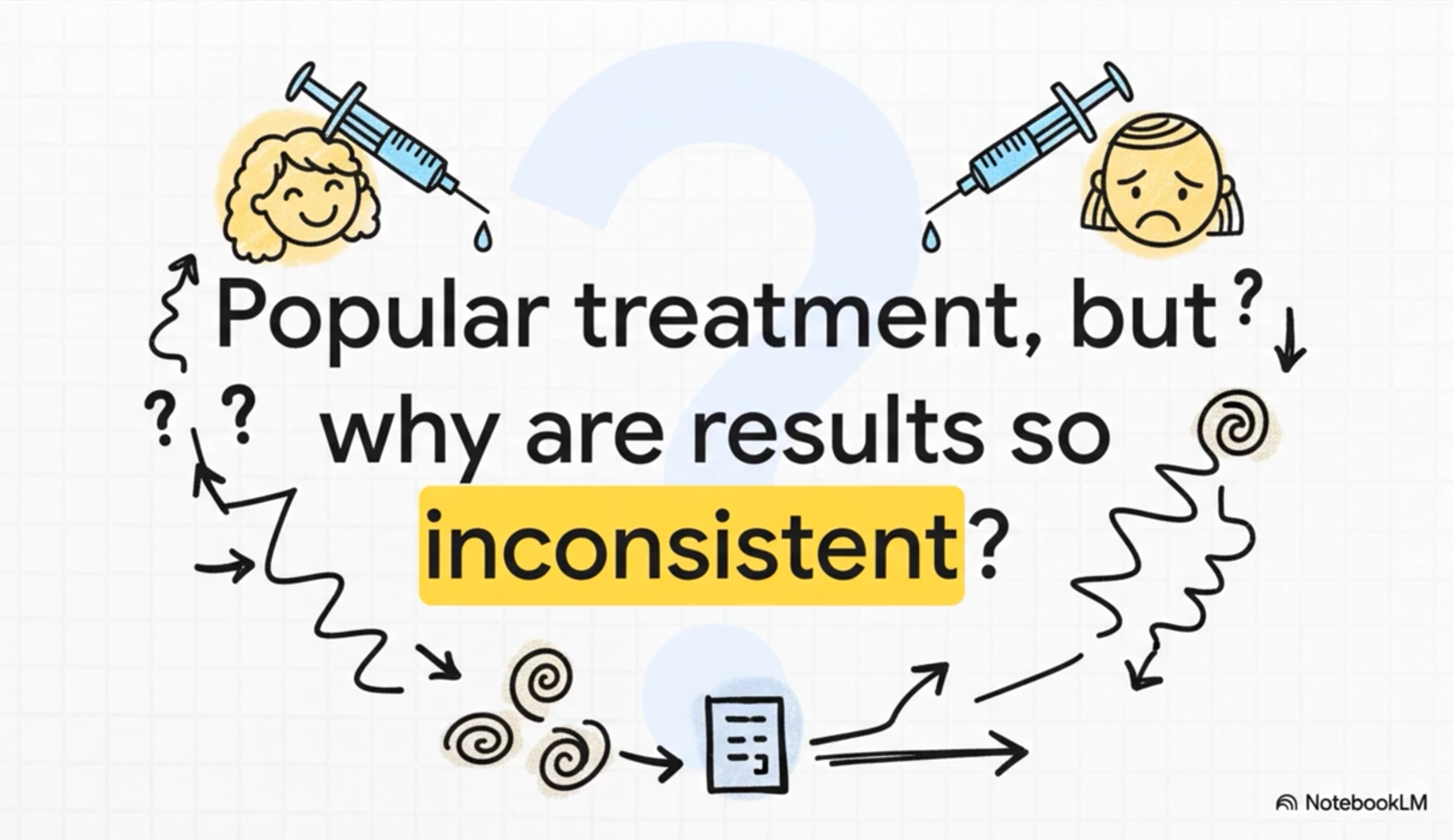
PRP can be inconsistent.
Not because PRP is “bad” (it’s one of the most widely used, physician-accepted regenerative approaches), but because PRP is not one standardized product. It’s a preparation influenced by human biology + technique. That combination can produce very different “PRP messages” from one session to the next.
This blog explains why that variability happens, and introduces Precision Re-Engineered Efficacy Optimization (PREO), a way of refining platelet-derived signals so they are clearer, more consistent, and easier to reproduce
Start at the root: what is PRP in hair biology?
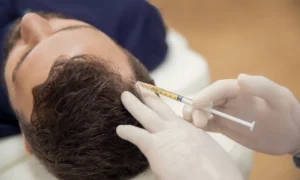
PRP is prepared by drawing blood, processing it to concentrate platelets, and delivering that platelet-rich fraction to the scalp.
Hair is also cyclical: follicles move through anagen (growth), catagen (regression), and telogen (rest). The goal in most hair-loss scenarios is not “magic new follicles overnight”—it’s a more supportive environment that can help follicles spend more time in growth, recover miniaturizing follicles earlier, and reduce pro-regression signals.
On the pathway level, many platelet-associated growth signals intersect with:
- PI3K–AKT (cell survival / anti-apoptotic tone)
- ERK/MAPK (proliferation and cell-cycle signaling)
- Angiogenic cascades (microcirculation support, often discussed around VEGF)
In simple terms: PRP is often used because it can deliver multiple signals that may support the follicle’s growth-friendly ecosystem.
Then why does PRP feel “variable” in real life?
1) The input changes: patient biology is dynamic
Blood is not a static raw material. Platelet count, inflammatory mediators, metabolic status, stress hormones, micronutrients, and hydration can shift over weeks (sometimes days). So the “starting composition” going into PRP can vary even for the same person.
2) The process changes: preparation protocols are not uniform
PRP can differ based on:
- Centrifugation speed/time
- Platelet concentration achieved
- Leukocyte content
- Red cell contamination
- The fraction collected
3) Activation changes what gets released and when
Platelets release signals differently depending on activation style:
- Calcium-based activation vs endogenous activation
- Immediate burst release vs more gradual release
- Differences in fibrin network formation influencing bioavailability
4) Delivery changes the “reach” of the message
Intradermal injection patterns, depth, spacing, scalp thickness, microneedling-assisted approaches, and session intervals influence how signals diffuse and interact with follicular units. Put together, PRP can range from highly growth-supportive to mixed-signal depending on variables that are hard to control perfectly every time.
The most important nuance: PRP contains both “accelerators” and “brakes”
The “accelerators” are the signals most commonly discussed as growth-supportive. Platelet preparations are known to carry a range of growth factors such as PDGF, VEGF, IGF-1, EGF, FGF-family factors, and HGF, among others. Within this group, a few are especially relevant when we think about follicle support:
- PDGF is often discussed around dermal signaling, matrix remodeling, and support of mesenchymal cell activity. It can intersect with ERK/MAPK and other cell-growth pathways.
- IGF-1 is frequently linked conceptually with PI3K–AKT, supporting cell survival and anti-apoptotic tone.
- VEGF-related signaling is associated with microvascular support—important because follicle health is energy-demanding and sensitive to perifollicular circulation.
- HGF (Hepatocyte Growth Factor): commonly included in PRP growth-factor lists and linked with regenerative signaling through c-MET pathways in broader tissue contexts
The “brakes” are the counter-signals that can dilute a pro-growth message. Platelets don’t carry only stimulatory factors; they also store natural inhibitors and “stop” cues. In PRP, this can include growth-inhibitory signals like TGF-β (often linked to regression-leaning biology via SMAD pathways) and anti-angiogenic mediators such as PF4/CXCL4 and thrombospondin-1, which can counter vascular support signals. Another practical brake is inflammatory noise, especially in leukocyte-rich preparations. Where cytokines like IL-1β and TNF-α may be higher, making the overall signal less clear and less predictable.
So, the same PRP session can send both growth-supporting cues and slowing cues depending on the balance of signals in that preparation. That mixed messaging is one plausible scientific reason for inconsistent outcomes.
This is where Precision Re-Engineered Efficacy Optimization (PREO) thinking comes in. It keeps the best idea behind PRP platelet-driven communication with the follicle but refines it so the message delivered to the scalp is clearer, more consistent, and repeatable. Instead of depending on whatever growth-factor mix happens to be present on a given day, Precision Re-Engineered Efficacy Optimization that follows four simple principles:
- Well-defined in composition
- Optimized in concentration and ratio
- Weighted toward stimulatory cues relevant to hair support
- De-emphasized for key inhibitory cues that may counteract the goal (e.g., lowering the contribution of catagen-leaning mediators such as TGF-β or FGF5)
This is not about saying PRP is flawed. It’s about acknowledging something simple: PRP has always had strong biological logic, but its “signal quality” can be inconsistent because it’s inherently variable. Precision Re-engineered Efficacy Optimization (PREO) tries to reduce that variability. Hair growth regulation is network biology. No single factor flips hair “on.”
A more precise, refined approach aims to deliver a clearer “pro-growth” message to the scalp supporting cell survival, healthy renewal, and a supportive scalp environment while minimizing mixed signals that can push follicles toward slowing down or shedding. In hair biology, it’s about orchestration, not overload.
Why this matters to real patients and real clinics
A defined, optimized platelet-inspired signal (PREO) may help in three practical ways:
- Consistency: less dependence on day-to-day fluctuations in the patient’s blood biology
- Predictability: clearer dosing logic and potentially more uniform clinical experiences
- Interpretability: better ability to study outcomes when the “input” is stable and reproducible
Important note: this is the rationale. The final word on any approach, classic PRP or refined platelet-inspired strategies, always comes from well-designed clinical evidence and appropriate patient selection.
The takeaway PRP remains one of the most widely used regenerative tools in hair practice because its core biological concept is strong. The limitation isn’t PRP as an idea. The limitation is variability. Precision Re-Engineered Efficacy Optimization (PREO) thinking is simply the next chapter: keep the foundational PRP logic, but refine the biology so the message to the follicle is clearer, more consistent, and less diluted by inhibitory noise. Not louder biology but Better-engineered biology.
Educational note: This content is intended for scientific awareness and does not substitute medical advice. Hair loss has multiple causes and requires a personalized medical evaluation.